



 Erwin Schrott affirms his vocal mastery at La Scala
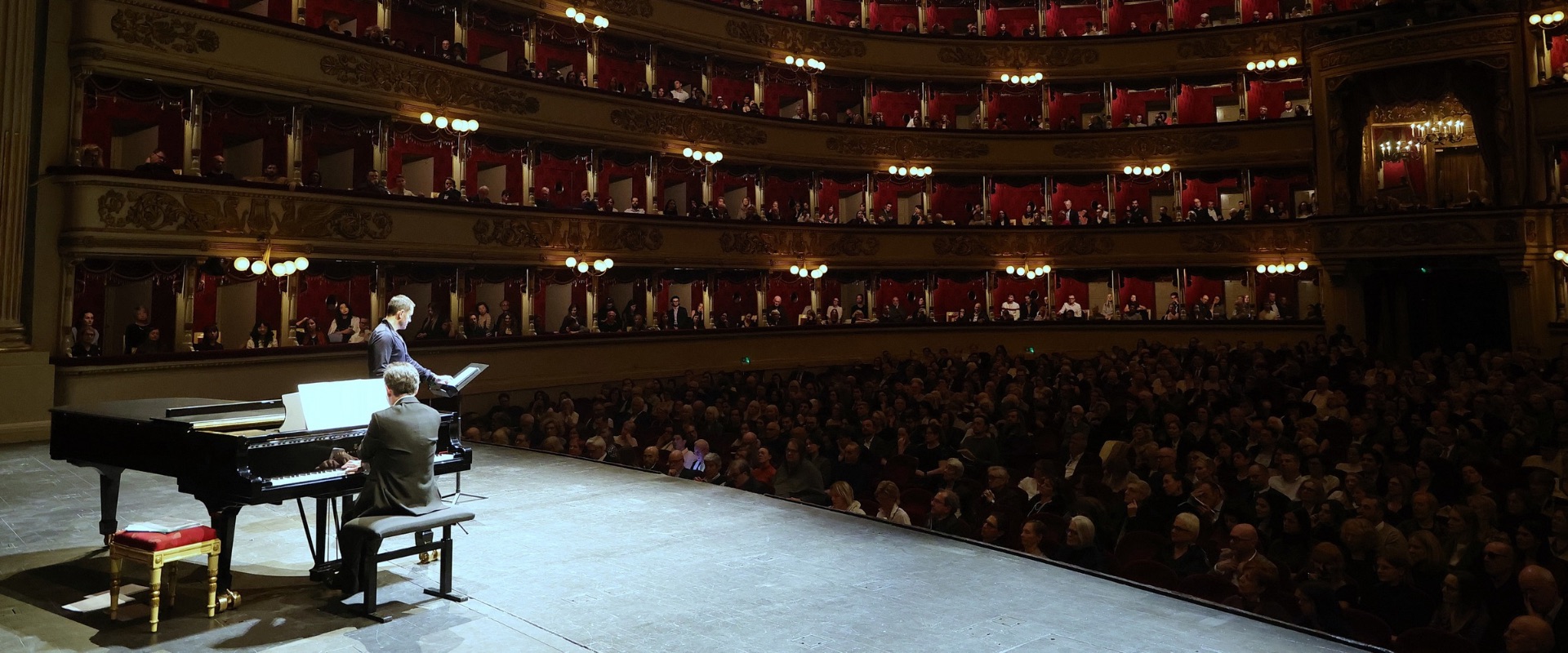
I went to La Scala for one reason: Erwin Schrott — the Uruguayan baritone with an impressive roster of roles, countless appearances on top stages, and, in the past, a marriage to Anna Netrebko. In recent years his career has slowed somewhat, and there have even been rumours about vocal decline and a reduced number of engagements. I had never heard him live before, so I decided it was time to fill that gap.
La Scala in Milan is an institution whose repertoire reaches well beyond opera, embracing ballet, symphonic programmes, visiting orchestras, major vocal recitals with the house orchestra and intimate chamber concerts. I attended one of these recitals.
It was scheduled in the theatre’s main auditorium, a place which – even after previous visits – still gives me a thrill of excitement each time I step inside. The room impresses with its scale and richness of detail: ornamentation, gilding, distinctive lighting and deep red seats. Knowing that world premieres of works by Verdi, Puccini, Rossini and Donizetti took place here, and that artists such as Maria Callas and Enrico Caruso stood on this stage, lends the space an extraordinary historical weight. It is a place one enters with natural reverence.

The building was designed by Giuseppe Piermarini in the Neoclassical style and opened on August 3, 1778, following a fire that destroyed the previous Regio Ducale theatre. The façade reflects the spirit of Neoclassicism, while the horseshoe-shaped auditorium, surrounded by four tiers of boxes, was conceived with acoustics in mind. Today La Scala remains one of the world’s leading opera houses, with an audience capacity of around two thousand.
The audience that gathered for the recital was distinctly international. Alongside Italian, one could hear many European languages, as well as English and several Asian languages. As is increasingly common in opera houses, audience attire ranged widely: from traditional elegance to fully tourist casual. Seating was overseen by a team of ushers dressed in the theatre’s traditional livery – black outfits and gold chains with medallions bearing the theatre’s emblem. This insignia signifies their role and is part of La Scala’s visual identity. Theatre historians note that the exact moment these uniforms were introduced is unknown; they most likely appeared in the 1920s, during Toscanini’s reforms and the transformation of the institution into the “Ente Autonomo.” The medallion still bears the inscription “TEATRO ALLA SCALA – ENTE AUTONOMO.”
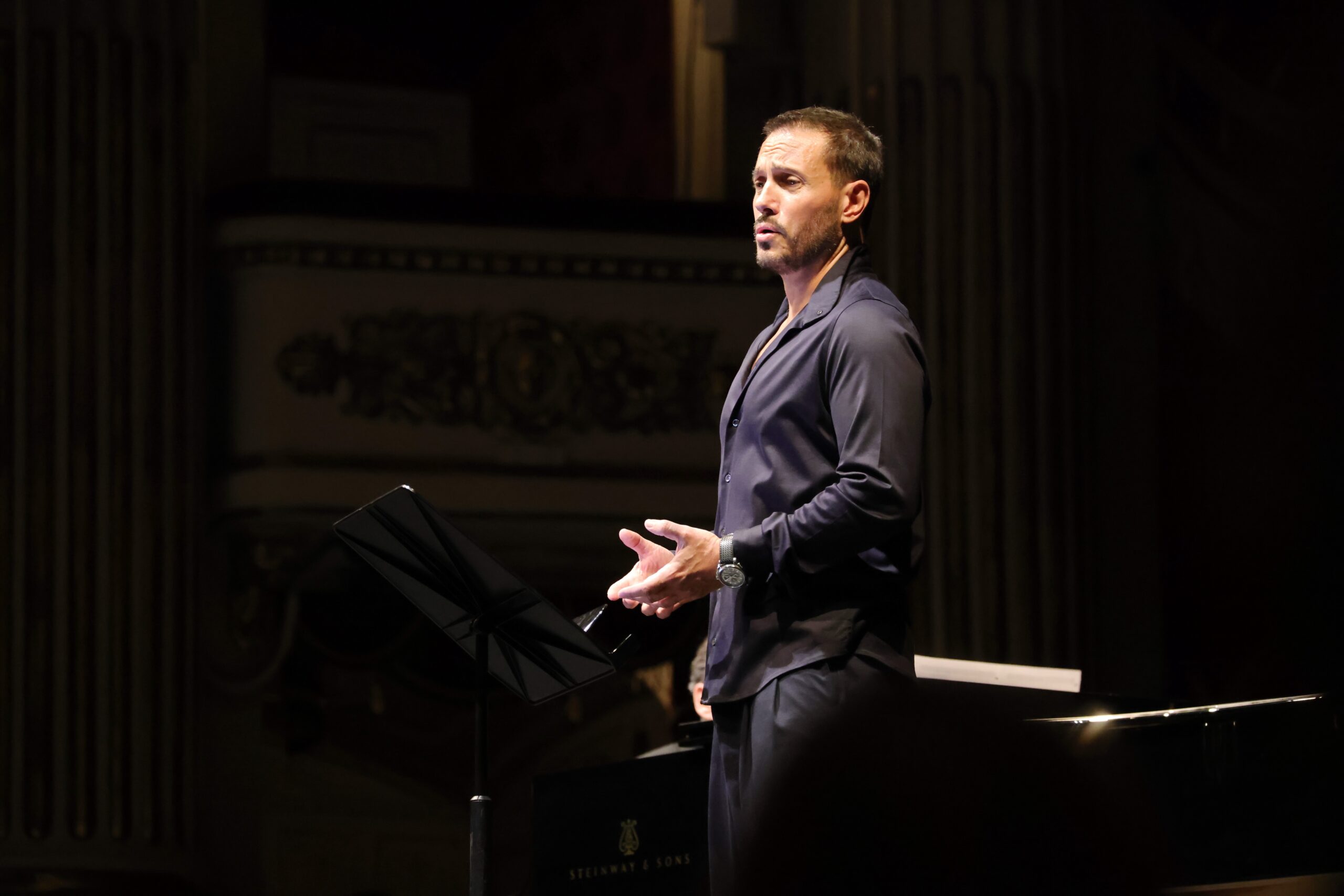
A concert grand piano awaited in front of a lowered backdrop that shut off the stage’s depth, and the orchestra pit was hidden from view. The lighting sank into an atmospheric dusk, then sharpened onto the stage, revealing the star of the evening. Erwin Schrott was dressed elegantly but in a style somewhat unconventional for this venue: a silk shirt open at the chest, dark trousers and shoes with thick tractor soles. Elegant nonchalance and ease.
This was not a typical recital. The bass-baritone devoted a considerable portion of the evening to spoken introductions – all in Italian – which, unsurprisingly, delighted the Italian part of the audience while severely testing the patience of everyone else. After an extended monologue, the pianist entered: Alessandro Amoretti, an Italian pianist and esteemed vocal coach known for his collaborations with Europe’s major opera houses. Amoretti has accompanied singers for years at festivals in Salzburg, Glyndebourne and Copenhagen.
The recital programme was surprisingly broad in style: from early Baroque miniatures by Cesti and Caccini, through Mozart’s classical concert arias, to late-Romantic and modernist songs by Liszt, Ibert and Rachmaninoff. It included both virtuosic pieces such as “Per questa bella mano,” lyrical love songs, and narrative cycles like Ibert’s “Chansons de Don Quichotte.” The evening closed with songs by Tosti, which allowed Schrott to descend from a monumental tone and reveal a more intimate side of his singing.
As mentioned, the singer interspersed the programme with lively commentary – appealing to anyone fluent in Italian but, for the rest, stretching the evening to near torment. Vocally, however, he sounded very good. He still commands a rich, dark voice that carries beautifully both in piano and forte. He sings with freedom and shapes phrases with elegance.
The entire programme maintained a moody, lyrical atmosphere, and since the recital lasted nearly three hours, a touch of fatigue crept in at times. I also missed a bit more energy and interpretative spark from the pianist, which might have added some dynamism. The audience nevertheless greeted Schrott with marked enthusiasm – he was rewarded with prolonged applause and, for his encore, delivered a superb rendition of King Philip’s aria from Verdi’s “Don Carlos,” which proved a splendid summation of the evening. The ovation was so fervent that he offered a second encore: “El Choclo,” the classic tango by Ángel Villoldo, ending the concert on a light, pleasant note.